
Ohio Public Records Act
Ohio's open-records law is the Public Records Act, ORC 149.43. It defines what counts as a public record, requires offices to allow inspection and provide copies within a reasonable time, and lists exemptions such as certain confidential law-enforcement work. An office cannot require you to explain why you want a public record, and if it denies a request, it must give the legal reason.
Court case records follow a different track. The Supreme Court of Ohio's Rules of Superintendence, Sup.R. 44 through 47, govern access to court records, with a presumption that case files are open. So a Sheriff report follows ORC 149.43, while a Common Pleas case file follows the court rules. The Ohio Attorney General publishes a Sunshine Laws guide that walks through the agency side of the process.
Court Rules vs. Agency Records
The two-track system trips up a lot of requesters, so it is worth a side-by-side look. Whether your record follows ORC 149.43 or the Supreme Court rules depends on who holds it, and that changes how you ask and where you appeal.
| Agency Records | Court Records | |
|---|---|---|
| Examples | Sheriff reports, Recorder deeds, Auditor data | Common Pleas, Domestic Relations, Probate case files |
| Rule | ORC 149.43, the Public Records Act | Sup.R. 44-47 |
| Request to | The agency's records office | The clerk or court custodian |
| Appeal path | Mandamus or Court of Claims | Court motion under Sup.R. 47 |
So a crash report and a divorce decree may both be public, but they travel through different doors with different rules.
What County Offices and Clerks Maintain
Butler County's records are spread across several custodians. The Clerk of Courts keeps Common Pleas General and Domestic Relations case records and Butler-originated Twelfth District appeals. Probate keeps estates and marriage records. The Sheriff keeps incident, offense, and crash reports. The Recorder keeps deeds and property documents, and the Auditor keeps tax and valuation data. Sending a request to the right office is the single biggest time-saver.
Ohio Legal Help lists the Clerk of Courts and what the office does.
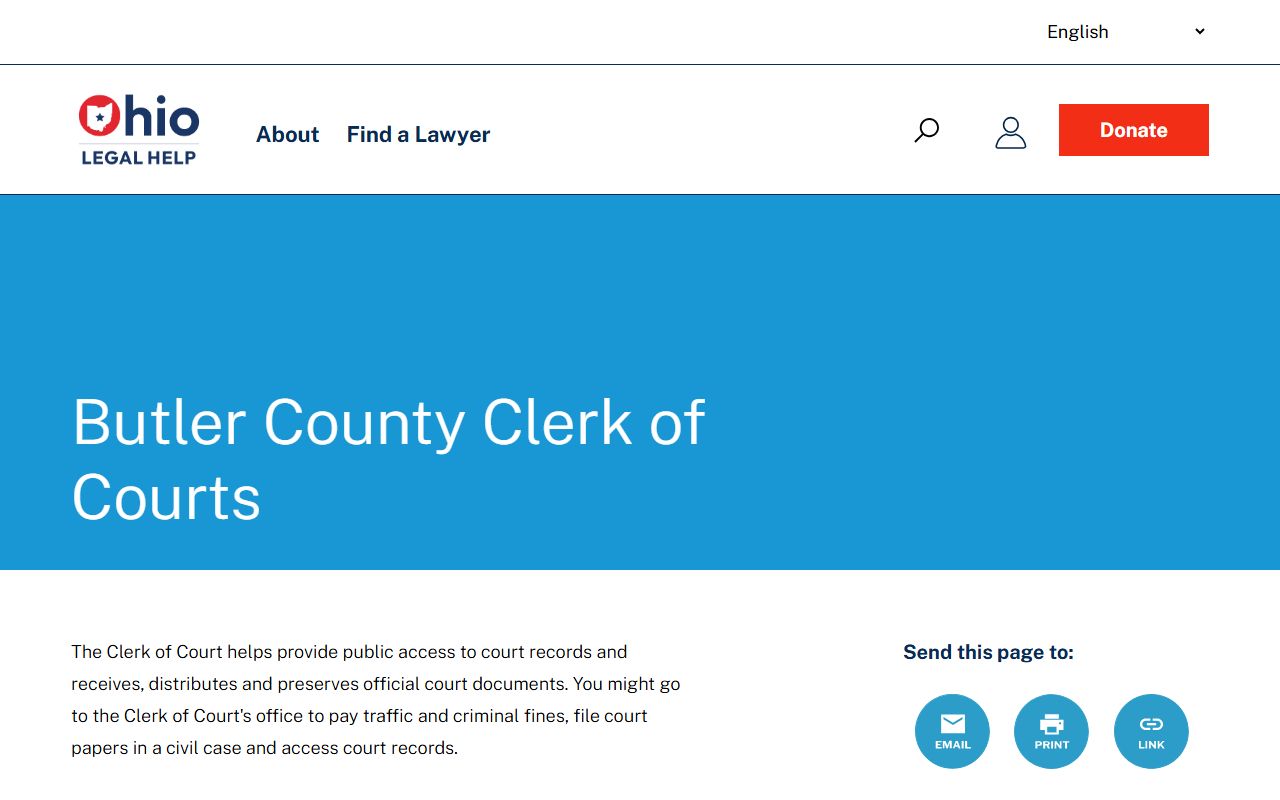
The Clerk of Courts listing notes the office helps the public access court records and receive official documents. The same site profiles the Common Pleas Court itself.
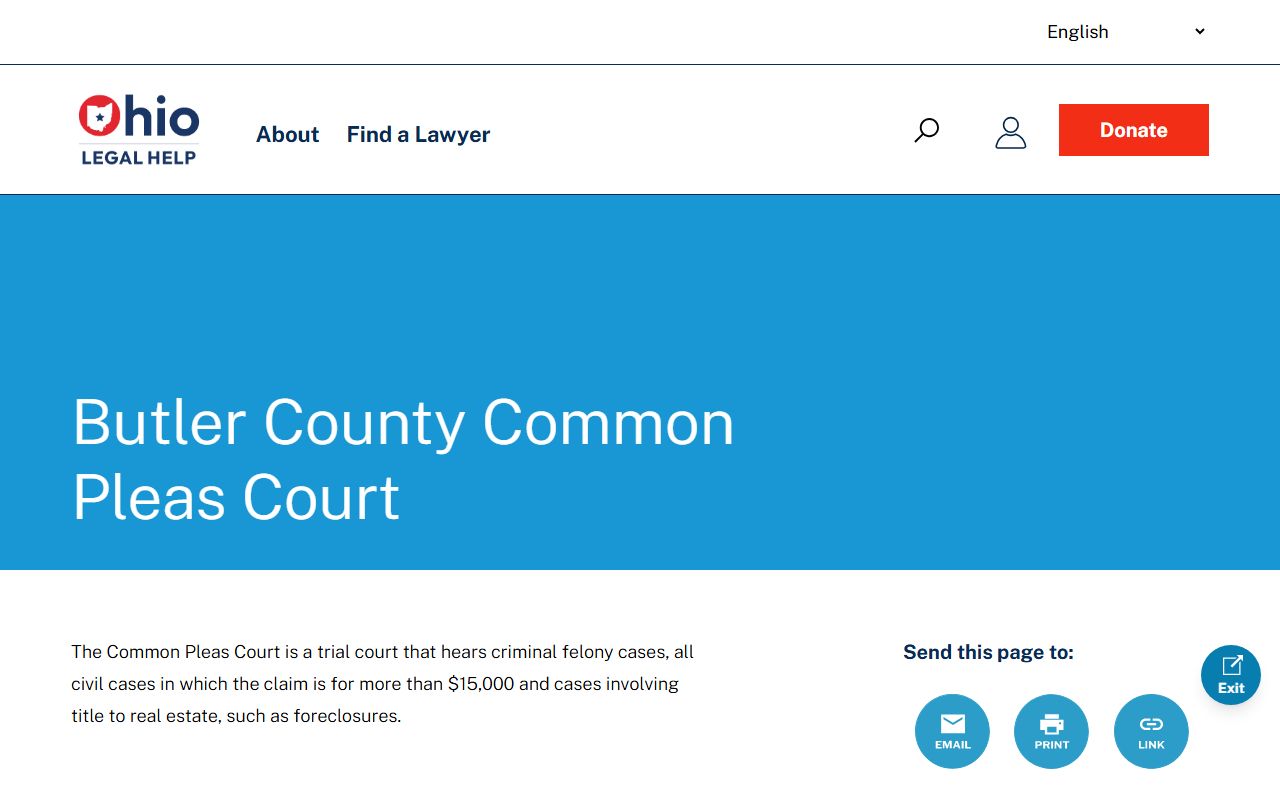
The Common Pleas listing gives the court's address and jurisdiction, which helps when you decide where to send a court-record request.
How to File a Public Records Request in Butler County
Ohio law does not require a special form for many requests, but a clear written request helps staff find the record. Name the office, the record, and any identifying details. A narrow request moves faster than a broad one.
- Identify the office that holds the record.
- Describe the record clearly: case number, date range, report number, names, or document type.
- Submit the request in person, by mail, by email, or on the office's form.
- State whether you want to inspect the record or receive copies.
- Provide contact information if you want copies mailed or emailed.
For a Sheriff report, the request goes to Central Records. For a Clerk court record, the Clerk's File Room handles it. The Clerk's form is limited to Common Pleas General, Domestic Relations, and Butler-originated Twelfth District cases, so probate, juvenile, area, and municipal records go to their own custodians.
Email works for many offices. The Sheriff accepts records requests by email at recordsrequest@butlersheriff.org, though it notes the inbox is not monitored around the clock, so an urgent matter is better handled by phone. The Clerk's File Room accepts requests by mail, email, fax, or in person. You do not have to use an office's form, but using it helps staff identify exactly what you want and can speed the response. Keep a copy of what you send, with the date, in case you need to follow up.
Public Records Request Form Fields
The Clerk's Public Record Request Form gathers contact details and a clear description of the records sought. Ohio law does not require all of these for every request, but they help the office respond accurately.
| Field Label | Type | Required | Notes |
|---|---|---|---|
| Requester name and contact | Text | Often optional | Used if copies are mailed or emailed |
| Case name / party name | Text | No | Provide exact names if known |
| Case number | Text | No | Best identifier for a court record |
| Records requested | Multiline text | Yes in practice | Describe pleadings, docket, entries, or transcripts |
| Delivery method | Checkbox | No | In person, mail, email, or fax |
Note: a request that names the office and the specific record is far less likely to be delayed for clarification.
Other County Record Offices
Beyond the courts and the Sheriff, several Butler County offices keep records the public uses every day. The Recorder holds deeds, mortgages, liens, and other land documents. The Auditor keeps property valuations, tax data, and ownership maps. The Board of Elections keeps voter registration and election records, and the county commissioners keep meeting minutes and resolutions. Each is its own custodian under ORC 149.43.
This matters for a clean request. A property question goes to the Recorder or Auditor, not the Clerk of Courts. A voter question goes to the Board of Elections. Matching the record to the office is the same principle that governs the court side, where felony cases sit with the Clerk and estates sit with Probate. When you are not sure, a quick call to the office saves a misdirected request.
Response Timelines
Ohio law does not set a rigid deadline. It requires inspection promptly and copies within a reasonable period, judged by the facts of the request. A simple, narrow request can be filled quickly, while a broad or voluminous request takes longer. The Sheriff notes that crash reports can take up to five days to be completed and approved, and that deputies have 72 hours to finish a report.
If a request is unclear or overbroad, an office can ask you to narrow it rather than deny it outright. A focused request that names the record and the date range avoids that back-and-forth and gets you to the record sooner. Asking for "all records about a person" is the kind of broad request that often triggers a clarification or a delay.
Public Records Fees in Butler County
Inspection of public records during business hours is generally free under Ohio law. Offices may charge the actual cost of copies. Some county fees are set by statute, and a few specific amounts are published. Confirm the current charge with the office before you order copies.
| Item | Amount |
|---|---|
| Record inspection | Generally free during business hours |
| Sheriff incident or offense report | Free |
| Sheriff traffic crash report (office copy) | $4.00, cash only |
| Online crash report (Ohio DPS portal) | No cost |
| Clerk court-record copies | Set under ORC 2303.20; confirm at the counter |
The Clerk's fee authority is ORC 2303.20, and the Public Records Act itself is ORC 149.43.
Records That Are Exempt or Redacted
Not everything is public. ORC 149.43 protects certain confidential law-enforcement investigatory work and other categories. Court rules close juvenile, adoption, and mental-health records and require redaction of personal identifiers. The Sheriff's records page gives a concrete example: any report listing an uncharged suspect will redact that suspect under ORC 149.43(A)(2)(a). Sealed and expunged cases also drop out of public access.
Sealing follows its own statute and procedure.
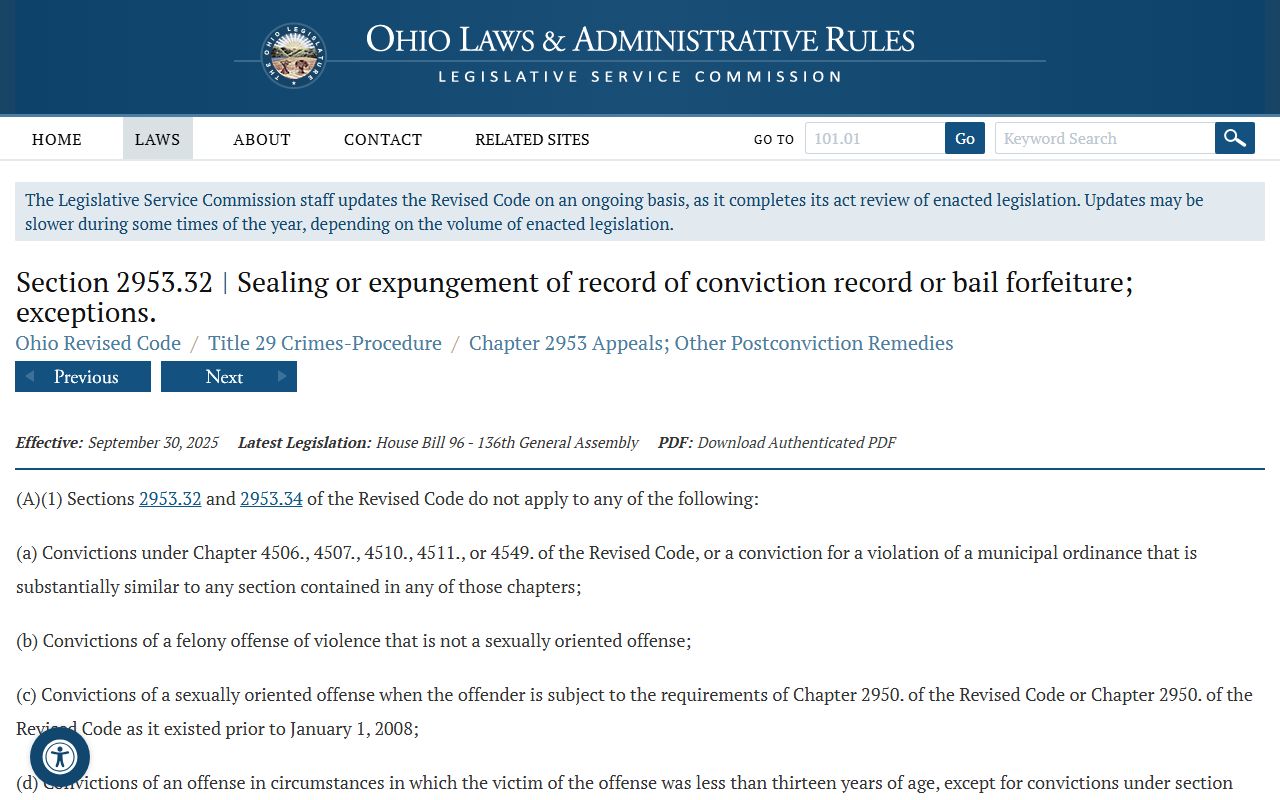
ORC 2953.32 sets the procedures for sealing eligible conviction records, which the arrest records page covers in more depth.
If Your Request Is Denied
A denial must come with a legal reason. If you believe an agency wrongly withheld a record, Ohio offers two main paths. You can file a mandamus action in court, or you can use the Ohio Court of Claims public-records process, which is built to be faster and less costly. Court-record denials are handled through the court's own rule mechanisms, with motions to obtain or restrict access under Sup.R. 47.
Before escalating, it often helps to ask the office to point to the specific exemption it relied on. Many disputes resolve when a request is narrowed or a redaction is explained, without the need for a formal action. Keeping a dated copy of your request and any reply helps if you do decide to pursue one of the formal paths.