
Getting a Marriage License in Butler County
Butler County marriage licenses are issued by Probate Court, not the Clerk of Courts. The Probate homepage posts a clear rule: no marriage-license walk-ins are accepted after 3:30 p.m. Probate's general hours are Monday through Friday, 8:30 a.m. to 4:30 p.m., and the office is closed on county holidays. Because of a fire in the Historic Butler County Courthouse, Probate is temporarily operating from the Government Services Center at 315 High Street in Hamilton.
For Ohio residents, one or both applicants must live in Butler County for Butler Probate to issue the license. Nonresidents marrying in Ohio generally apply in the county where the ceremony will take place. Both applicants must meet ID, age, and legal-capacity rules. After the ceremony, the officiant returns the license for recording.
How to Apply for a Marriage License
The process is straightforward when you bring the right documents and arrive before the walk-in cutoff. Review the Probate marriage instructions first, since they spell out the ID and residency rules.
- Read the Probate Court marriage instructions, available in English and Spanish.
- Complete the application for obtaining a marriage license.
- Confirm residency: one or both applicants must be a Butler County resident for Ohio residents.
- Bring government photo ID and meet the age and capacity rules.
- Apply in person before 3:30 p.m., since no walk-ins are accepted after that.
- After the ceremony, the officiant returns the license to Probate for recording.
Certified marriage copies are requested from Probate Court after recording, which is the office that holds the marriage file.
Marriage License Application Fields
The Ohio probate marriage application asks for identity, residency, and background details for both applicants. Some fields, such as a Social Security number, are required by law but are not part of the public record.
| Field Label | Type | Required | Notes |
|---|---|---|---|
| Applicant full legal names | Text | Yes | As shown on ID |
| Residence address | Text | Yes | Sets county eligibility for Ohio residents |
| Date of birth / age | Date | Yes | Used for age eligibility |
| Place of birth and parent names | Text | Yes | Standard Ohio marriage fields |
| Prior marriage status | Checkbox | Yes | Divorce or death details if previously married |
| Signature / oath | Signature | Yes | Applicants swear the application is accurate |
Note: a Social Security number may be required by law but is kept confidential and not displayed publicly.
Butler County Marriage and Divorce Fees
Marriage and divorce fees are set by statute and by court cost schedules, not by a private site. Probate fees run under one statute and Clerk fees under another, and Probate publishes a current court costs document. Confirm the exact dollar amount with the court before you pay, since schedules change.
| Item | Amount |
|---|---|
| Marriage license (Probate) | Set in the Probate court costs schedule; confirm with Probate Court |
| Certified marriage copy (Probate) | Set under ORC 2101.16; confirm with Probate Court |
| Divorce or dissolution filing (Clerk) | Set under ORC 2303.20; confirm with the Clerk |
| Certified divorce decree copy (Clerk) | Set under ORC 2303.20; confirm with the Clerk |
The probate fee authority is ORC 2101.16, and the Clerk's fee authority is ORC 2303.20.
How to Look Up Butler County Marriage Records
Marriage records are searched through Probate Court's CaseLook system. The disclaimer warns that data can lag a filing by at least 24 hours. A marriage-license record can show the applicants, the application date, the license issue date, the officiant return, and certificate or copy information, though sensitive identifiers are not public.
To search, open the Probate CaseLook system, accept the disclaimer, and enter one piece of information at a time, such as a name. The system lets you pick case types and set how many matches show per page. Because the disclaimer notes a posting lag, a very recent license may not appear right away, so call Probate if a record you expect is missing.
For estate, guardianship, and other probate matters beyond marriage, the probate records page covers the same court and its CaseLook search in more detail.
How to Find Butler County Divorce Records
Divorce, dissolution, legal separation, and annulment cases are handled by the Domestic Relations Division of the Court of Common Pleas. The Clerk of Courts keeps the legal record. To search, use the Clerk's eServices portal for Domestic Relations dockets, where you can see filings, hearings, parties, attorneys, and disposition. Financial, minor-child, medical, and protected-address details may be restricted or redacted.
The Domestic Relations Court site is the entry point for divorce information.
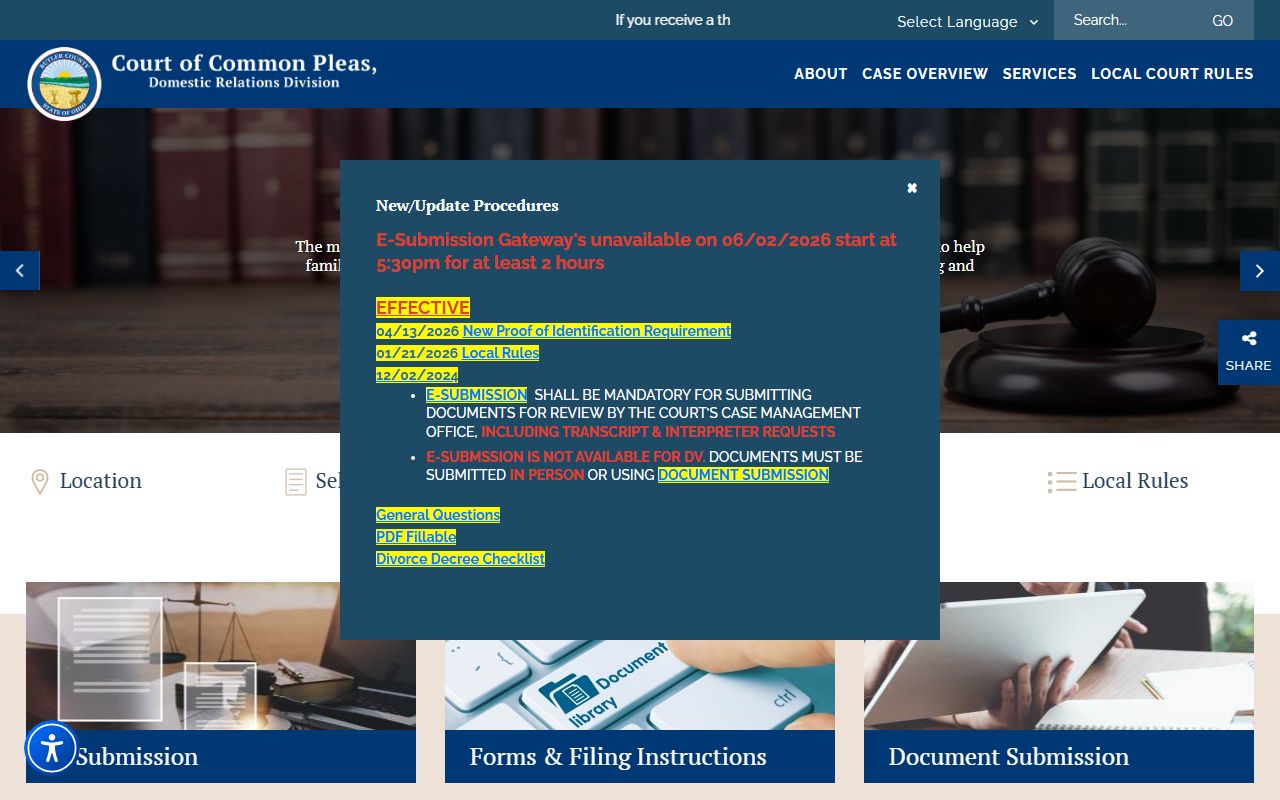
The Domestic Relations Court posts a useful safety warning: the court will never use a phone call or email to collect payment or financial information. Treat any such demand as a scam.
Filing for Divorce in Butler County
Filing starts with the right venue and the right type of case. Ohio offers divorce, dissolution, legal separation, and annulment, and the path differs for each. A dissolution is an agreed end to a marriage, while a divorce is contested. With children, the court requires parenting affidavits and financial disclosures.
- Confirm residency and venue under Ohio domestic-relations law.
- Choose divorce, dissolution, legal separation, or annulment.
- Prepare pleadings, financial disclosures, and parenting affidavits if there are children.
- File with the Clerk of Courts for the Domestic Relations Division at 315 High Street.
- Serve the other party and attend the hearings the court schedules.
- Request certified copies of the decree from the Clerk once the case is final.
Free guidance is available for people handling a case on their own.
Ohio Legal Help offers guided help for divorce, custody, and family matters, and it hosts Butler County resource pages.
Confidential Family and Child Information
Divorce and family files carry sensitive material, and Ohio rules keep parts of it out of public view. A docket may show that a financial affidavit or a parenting plan was filed while the attachment itself stays restricted. Minor-child identifiers, medical records, abuse-related details, and protected addresses are commonly redacted or sealed. So a public divorce search can confirm that a case exists, who the parties are, and how it ended, without exposing every private detail inside.
This protects children and victims while still keeping the core court record open. If you are a party to the case, you can access more than the public sees, but you may need to ask the Clerk or the court for restricted material. The Domestic Relations Court's scam warning fits here too: the court will not call or email you to demand payment, so guard your financial information during a case.
Getting Certified Copies
The office you ask depends on the record. A certified marriage copy comes from Probate Court, since Probate issues and records marriage licenses. A certified divorce decree comes from the Clerk of Courts, since the Clerk holds the Domestic Relations legal record. For either, search the case first, then request the certified copy at the counter with a photo ID and payment. Say "certified copy" so staff issue the version with the seal that agencies accept. A plain copy may be fine for personal files, but most legal and government uses call for the certified version.
An online docket view is not certified. For a name change, a remarriage, immigration, or a benefits claim, you will almost always need the certified copy, not a screen print.
Ohio Vital Records and Related Offices
It helps to know what Probate does not handle. Ohio birth and death certificates are generally vital records kept by a local health department or the Ohio Department of Health, not by Probate, except for probate proceedings like a delayed or corrected birth registration. Probate handles marriage licenses, name changes, and certain birth corrections, but it is not the county's general vital-records office for every certificate.
So for a birth or death certificate, go to the health department. For a marriage license or a certified marriage copy, go to Probate. For a divorce decree, go to the Clerk. Matching the record to the office avoids a wasted trip and a delayed request. The same rule applies to a name change, which Probate handles, and to a support or custody order, which travels with the Domestic Relations case file at the Clerk.