
What Probate Covers in Butler County
Probate Court handles the legal matters that follow a death and several protective and personal proceedings. Its services page lists decedent estates, guardianships, conservatorships, adoptions, marriage licenses, name changes, mental-health matters, minor settlements, trusts, birth registrations and corrections, disinterments, and wrongful-death approvals. Judge John M. Holcomb presides. It is a division of the Court of Common Pleas, but it runs with its own staff, forms, and record search.
The services page lays out the court's full jurisdiction.
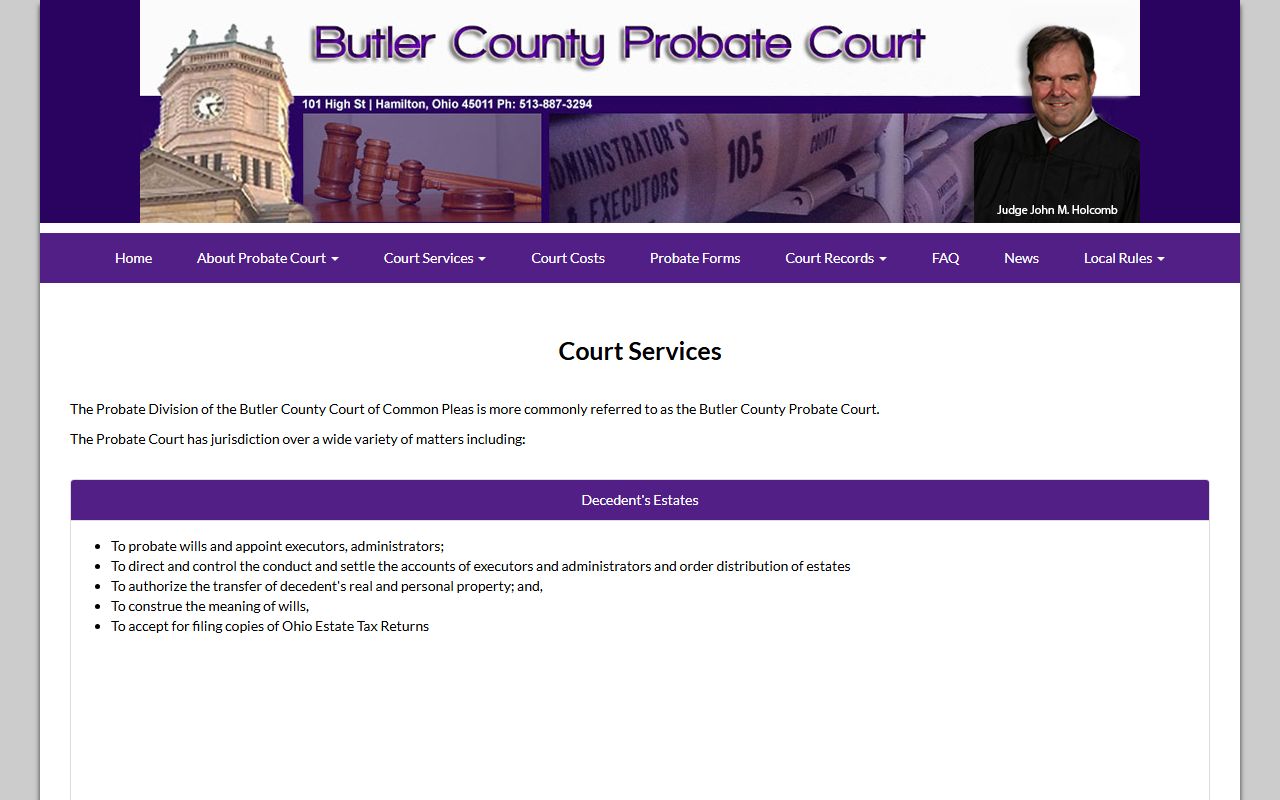
The Probate services page is a good first stop to confirm whether your matter belongs in Probate or another court. Marriage and divorce sit partly here and partly with Domestic Relations, which the marriage and divorce records page sorts out.
Probate also hears a narrow set of civil actions tied to its jurisdiction, such as will contests, trust construction, and concealment of estate assets. Most ordinary civil lawsuits do not belong in Probate; they go to the General Division of Common Pleas. Getting this right at the start matters, because filing in the wrong division delays a case and can mean refiling. When the matter is an estate, a guardianship, a trust, a name change, or a marriage, Probate is the court. When it is a general civil dispute, the General Division is.
Probate Terms Defined
Probate uses a vocabulary that can slow down a first-time reader. A short glossary makes an estate or guardianship file far easier to follow.
- Testator
- The person who made a will.
- Executor
- The person named in a will to settle the estate.
- Administrator
- The person the court appoints when there is no will or named executor.
- Intestate
- Dying without a valid will.
- Guardian
- A person appointed to make decisions for a minor or an incompetent adult.
- Conservator
- A person appointed to manage another adult's affairs, often with that adult's consent.
How to Search Butler County Probate Records
Probate runs a CaseLook search at probatecourt.bcohio.gov. The system shows a disclaimer first, warning that data can lag a filing by at least 24 hours. The active search form lets you enter one piece of information at a time, pick case types, set matches per page, and run the search.
- Open the Probate CaseLook page and read the disclaimer.
- Click to continue to the search form.
- Enter one search criterion, such as a decedent or party name.
- Select the case types you want and set matches per page.
- Run the search and open the matching case.
For a deceased parent's estate, search by the decedent name if you do not have the case number. If the online record looks incomplete, contact Probate Court, since the disclaimer notes verified information requires reaching the court directly. Because the court is operating from its temporary location, confirm the public counter location before you go in person to view or copy a file.
Probate Court Location and Fire Relocation
The Probate Court's permanent home is the Historic Butler County Courthouse at 101 High Street, Second Floor, in Hamilton. Because of a fire in that building, the court is temporarily operating from the Government Services Center at 315 High Street until further notice. Hearings are held on the 4th floor of the Government Services Building, and visitors enter through security on the 2nd floor. Confirm the current public counter location before you visit.
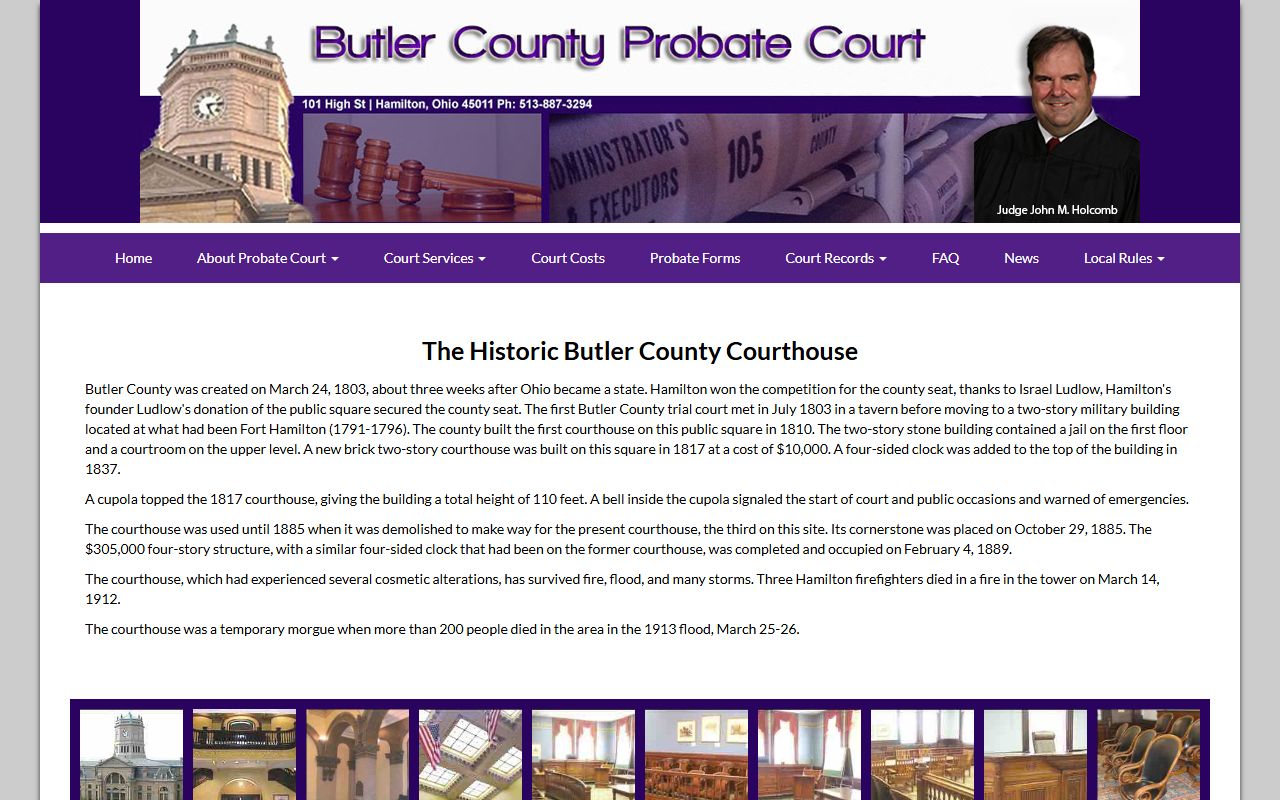
The court's history page covers the historic courthouse and the county's early courts.
Butler County Probate Court
315 High Street (temporary)
Permanent: 101 High Street, 2nd Floor
Hamilton, OH 45011
(513) 607-4341
probatecourt@bcohio.gov
Probate Filings
315 High Street (temporary)
Hamilton, OH 45011
(513) 887-3294
Mon–Fri, 8:30 a.m.–4:30 p.m.
Probate Filing Fees
Probate fees and costs are set by statute and by the court's cost schedule, not by a private site. The court publishes a current court costs document, and the fee authority is in the Ohio Revised Code. Confirm exact amounts with Probate Court before filing, since estate and guardianship deposits vary by case type.
| Item | Amount |
|---|---|
| Estate / guardianship filing deposit | Set in the Probate court costs schedule; confirm with the court |
| Certified copy | Set under ORC 2101.16; confirm with the court |
| Marriage license | Set in the Probate court costs schedule; confirm with the court |
The probate fee authority is ORC 2101.16, which governs probate judge fees and costs.
Steps in Estate Administration
Settling an estate follows a set order, and the Probate docket tracks each step. Knowing the sequence helps you read a case and spot where it stands.
- Decide whether the estate needs full administration, a release from administration, or summary release under Ohio probate procedure.
- File the application, the death certificate, the original will if any, and the list of next of kin.
- The court appoints a fiduciary and issues letters of authority if appropriate.
- The fiduciary gives notice, gathers assets, handles creditor claims, and pays debts, taxes, and costs.
- The fiduciary files an inventory and accounts, then distributes the assets.
- File the final account and closing documents.
A guardianship follows a parallel path, from the application and expert evaluation through appointment, bond, periodic reports, and termination.
Guardianship and Conservatorship Records
Probate Court appoints guardians for minors and for adults who cannot manage their own affairs. A guardianship case protects a person, called the ward, by giving a court-supervised guardian authority over decisions about care, finances, or both. A conservatorship is a related arrangement, often used when an adult consents to having someone manage their affairs. These cases stay under court oversight, with periodic reports and accounts.
A guardianship record can show the application for appointment, a statement of expert evaluation, an investigator report, the hearing notice, the guardian appointment, the bond, the guardian's reports, accounts, and any termination. Because these files touch a person's health and finances, sensitive details may be redacted even when the case itself is public. Anyone considering a guardianship should review the Probate forms and may want legal help, since the duties of a guardian are ongoing and enforced by the court.
Marriage, Name Changes, and Birth Corrections
Probate handles several personal matters beyond estates. It issues marriage licenses and keeps the marriage-license records, hears name-change petitions, and manages delayed or corrected birth registrations. These are distinct from general vital records. Ohio birth and death certificates are usually kept by a local health department or the Ohio Department of Health, not by Probate, except for the probate proceedings that correct or establish a birth record.
A name-change record can show the petition, the notice, and the order, where public. A marriage-license record shows the applicants, the application and issue dates, and the officiant return. For the full marriage-license process and the divorce side handled by Domestic Relations, the marriage and divorce records page walks through both. So when you need a certificate, match the document to the office: Probate for marriage and name changes, the health department for birth and death.
What Butler County Probate Records Show
Probate cases use case categories rather than adversarial captions. An estate is styled as "Estate of" a decedent, and a guardianship as "Guardianship of" a person. The docket records the filings and orders that move the case along.
| Field | What It Shows |
|---|---|
| Case Number and Type | Estate, guardianship, conservatorship, name change, or marriage |
| Decedent or Protected Person | The person the case concerns |
| Fiduciary | Executor, administrator, guardian, or trustee |
| Key Filings | Will, letters of authority, inventory, accounts, and closing entries |
| Attorney | Counsel of record, where public |
Note: mental-health and adoption matters are confidential and may not appear like ordinary estate records.
Restricted Probate Records
Some probate matters are closed by law. Adoption records are confidential under Ohio statute, and access usually requires statutory authorization or a court order. Mental-health proceedings are protected and may be entirely unavailable to the public. These are not searchable like an ordinary estate file.
The adoption confidentiality statute sets these limits.
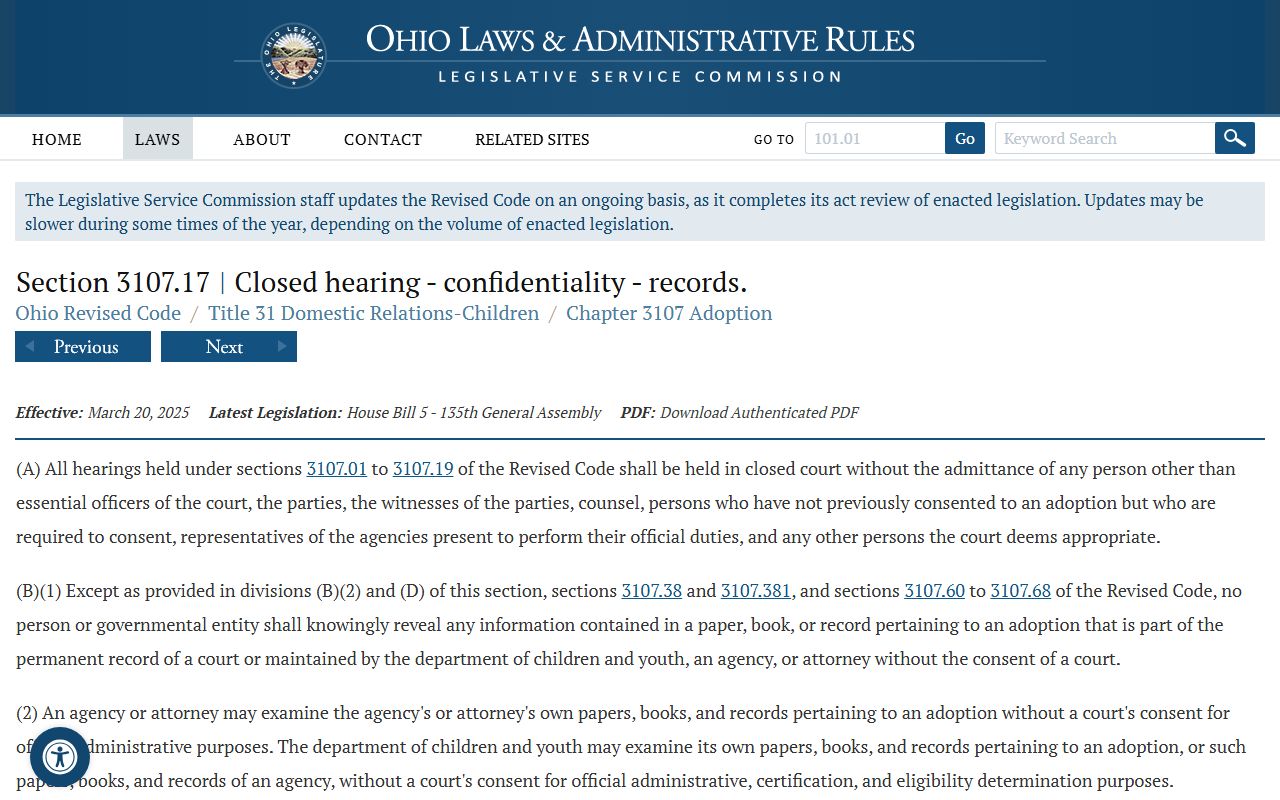
Read ORC 3107.17 for the adoption confidentiality rule. Estate and guardianship records, by contrast, are generally open, subject to redaction of sensitive identifiers. If you are unsure whether a particular file is open, ask Probate Court before assuming, since the answer turns on the case type rather than a single rule for all probate records.